Live Support Session
Pigment Clarity, Better Removal Decisions, and Why PMU Pro Exists
This months’s Botched Ink live was exactly what I want these sessions to be: real technicians, real questions, and the kind of discussion that actually makes you better at removal work.
If you want to watch the full replay, it’s available inside PMU Pro Network® - Botched Ink Live with Lisa ➔
It wasn’t a presentation. It wasn’t me lecturing at you for an hour. It's a monthly support session. PMU artists can ask questions in chat, come on screen, or just sit and watch, but the whole point is that you’re not doing this alone.
And that’s the bigger picture: most artists don’t need more “content”. They need a place where the questions can be asked without it turning into a Facebook circus.
Training is only half the job. Support is the other half.
We started by talking about moving training platforms. If you trained on the old Thinkific setup, you’ll immediately feel the difference with PMU Pro. It’s easier to access, easier to navigate, and the support is built into it.
The part I love most is the chat and voice notes inside the support space while you’re training. You can actually talk to each other while you’re working through the course, and that makes a huge difference in confidence and consistency.
It’s not “do the course and disappear.” It’s training + support + ongoing updates, all in one place. That’s what people actually need.
Facebook groups are failing the industry (and everyone knows it)
It’s obvious at this point: Facebook groups are struggling. You can’t trust your feed. You don’t see everything. Posts get buried. Engagement dies unless the group is massive or controversial.
And that’s not me being dramatic — it’s just what’s happening.
That kills community, and this industry needs community more than it needs another trend.
Botched Ink has always had a strong Facebook support group, and I’m not saying “leave Facebook.” There’s years of value in the group. But I’m building the next stage here, because it needs to be habit-forming and reliable.
Pigment information isn’t “extra”. It’s removal judgement.
We got into one of my favourite topics, because this is where removals go from stressful to predictable: pigment literacy.
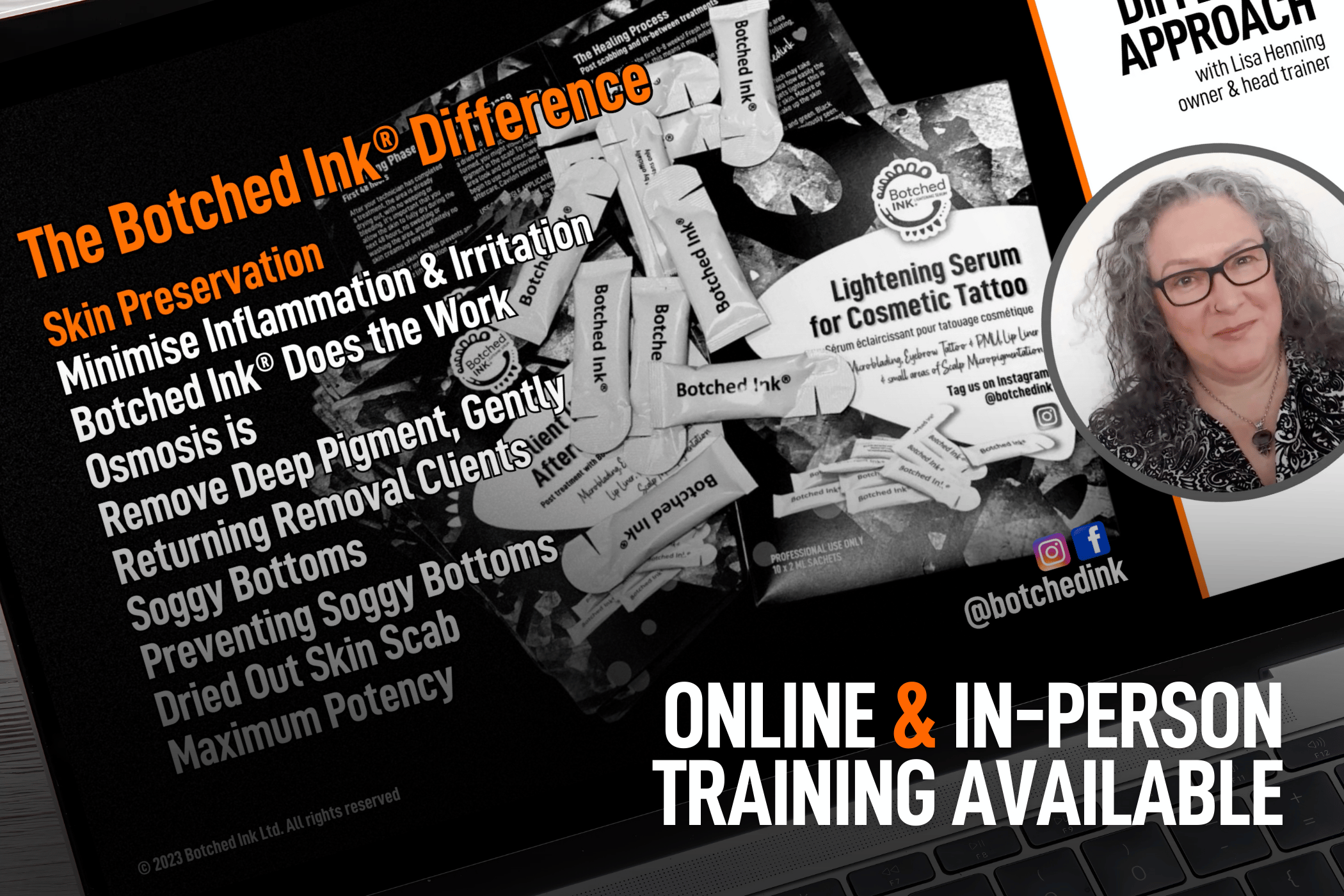
The training course was upgraded at the end of 2023 to include a lot more pigment information for a reason. Understanding pigments helps you understand removal. It helps you read what you’re looking at and make better calls.
Carrier fluids matter. Pigment types matter. Fade behaviour matters. Staining matters. What’s likely to lift first matters. If you know what you’re working with, you stop guessing and start deciding.
And if you’re doing removals, that’s everything.
Skin stain: calling it what it is
We talked about skin stain as well, because it’s still one of the most misunderstood things in PMU.
When pigment degrades over time, especially with iron oxides, it can behave like a stain. It doesn’t always “fade out nicely” the way people expect. That’s not fearmongering. It’s just what happens.
If you’re removing brows and you’re not thinking about stain behaviour, you’ll end up confused by results that are actually completely logical.
Organic vs inorganic: why hair strokes look different
We touched on organic vs inorganic pigments, especially in the context of hair strokes.
This is one of those conversations technicians need to be having more openly, because it affects everything: crispness, longevity, how it heals, and what it looks like a year later.
Some brands are super finely milled and fade evenly. Some hold harder. Some look amazing fresh and behave differently over time. None of that is “good or bad” in isolation. The problem is when the technician and the client don’t understand what they’re choosing.
And that’s where removals come in, because removal work is often the clean-up crew for expectations that were never set properly in the first place.
“Colour toning” is removal, but clients understand it better
We got into the phrase colour toning, and I actually think it’s useful.
A lot of clients hear “removal” and instantly assume disaster. They think you’re telling them their brows are bad, or they’ve been botched, or something has gone wrong.
But so much of removal work isn’t about disaster. It’s refinement. It’s lifting. It’s softening. It’s toning down a grey cast. It’s creating space so you can rework properly.
Colour toning explains that without triggering the panic response.
It’s not “we’re removing your brows.” It’s “we’re toning them down so they sit better and rework cleanly.”
That’s the difference between a client agreeing calmly and a client saying "No!"
Botched Ink isn’t a solo brand. It’s a technician network.
This is the bit I keep coming back to because it’s the truth: Botched Ink grows when technicians grow.
If you’re getting results and you’re showing your work, the brand doesn’t need me shouting. The proof does the job.
That’s why I want more technicians tagging Botched Ink, and why I’m pushing collaborations on strong results posts. A collaborator post gets seen by your audience and ours, and it helps both of us.
It’s not fluff. It’s visibility and credibility, and it rewards good work.
PMU Pro Network is bigger than Botched Ink, and that’s intentional
Why would I build PMU Pro only for Botched Ink?
I don’t need a platform that’s just “my people.” The whole industry needs a better structure than social media chaos, and I want PMU Pro to be neutral enough that other trainers and brands can have a presence here too.
I want technicians to meet more technicians. I want students to have support beyond one trainer. I want good trainers to be visible because they actually show up.
It becomes discoverability, not competition.
And yes, competition can be healthy. Standards rise when people can see what “good” looks like.
The real theme of this live: better decisions, not more noise
If I had to sum up what this session was really about, it’s this: removal gets easier when your decisions get better.
Better pigment understanding. Better client expectation setting. Better language. Better community support. Better access to real answers.
That’s what I’m building here.
And if you’re a Botched Ink technician, you’re not meant to be doing this in isolation, guessing your way through removals and hoping you got it right.
Botched Ink may be one of the worlds most known removal brands, but it is just you and me.
We're stronger together.